



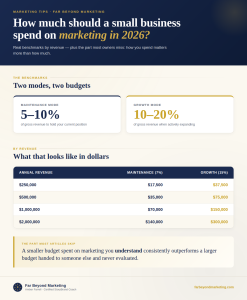
Short answer: Most small businesses should budget 5–10% of gross revenue for marketing if they’re maintaining their position, and 10–20% if they’re actively trying to grow. A business doing $500,000 a year should expect to invest roughly $25,000–$50,000 annually to grow. But the dollar amount matters far less than how you spend it — a smaller budget spent on a marketing system you understand consistently outperforms a larger budget handed to someone else and never evaluated.
The marketing budget question is one every business owner wrestles with, and the advice online is all over the map. Let me give you real numbers, the logic behind them, and the part most articles leave out.
The standard marketing budget benchmarks
Here are the figures used across most credible sources, including the U.S. Small Business Administration’s general guidance:
- Maintenance mode (holding your position): 5–10% of gross revenue
- Growth mode (actively expanding): 10–20% of gross revenue
- Newer businesses (under 5 years): often toward the higher end, because they’re still building awareness
So in practical terms:
| Annual Revenue | Maintenance Budget (7%) | Growth Budget (15%) |
|---|---|---|
| $250,000 | $17,500 | $37,500 |
| $500,000 | $35,000 | $75,000 |
| $1,000,000 | $70,000 | $150,000 |
| $2,000,000 | $140,000 | $300,000 |
These numbers surprise a lot of owners. If you’re spending dramatically less than this and wondering why growth is slow, the budget gap may be part of the answer.
What counts as “marketing spend”?
Your marketing budget isn’t just ad dollars. It includes:
- Advertising (Google, Meta, local, print)
- Tools and software (email platform, CRM, scheduling, design tools)
- Content creation (photography, video, copywriting, design)
- People (employees, freelancers, agencies, or your own time investment in learning)
- Education and strategy (courses, coaching, memberships that build your capability)
That last category is the one most owners forget — and it’s often the highest-return line item, because it makes every other dollar more effective.
Why the dollar amount matters less than you think
Here’s the part most budget articles skip: how you spend your marketing budget matters more than the size of it.
A business owner who spends $2,000/month on ads they don’t understand, managed by a vendor they can’t evaluate, often gets worse results than an owner who spends $300/month learning to run their own marketing and $700/month executing it well.
Why? Because marketing spend without marketing understanding is just expensive guessing. You can’t optimize what you can’t evaluate. The owners who get the best return aren’t the ones with the biggest budgets — they’re the ones who understand their marketing well enough to spend every dollar deliberately.
The smartest first investment for most small businesses
If your budget is limited, the highest-return first move usually isn’t more ad spend. It’s investing a small portion of your budget in understanding marketing well enough to spend the rest wisely.
Think of it like this: would you rather hand $5,000/month to someone else and hope, or invest a fraction of that in learning to direct your marketing yourself — keeping both the money and the knowledge?
For a business doing under $2M, a sensible 2026 allocation might look like:
- A small slice (often $100–$300/month) on education and guidance — a coach or membership that builds your capability
- The majority on execution — tools, content, and targeted advertising you now understand well enough to evaluate
This approach compounds. Every month you understand your marketing better, every other dollar works harder.
How much should a McKinney or Collin County business spend?
Local businesses in growing markets like McKinney, Frisco, Prosper, and Allen face a specific dynamic: the area is growing fast, which means both opportunity and rising competition. In a fast-growing local market, under-investing in marketing is especially costly because newer competitors are aggressively claiming attention. If you’re in a high-growth Collin County market, leaning toward the growth-mode end of the budget range (10–20%) is often justified — but only if you’re spending it on marketing you understand and can steer.
Frequently asked questions
What percentage of revenue should go to marketing?
Most small businesses should budget 5–10% of gross revenue to maintain their position and 10–20% if they’re actively trying to grow. Newer businesses typically need to spend toward the higher end to build awareness.
How much should a business making $500,000 spend on marketing?
A business at $500,000 in revenue should expect to invest roughly $35,000/year (7%) to maintain and up to $75,000/year (15%) to grow actively — though how effectively that’s spent matters more than the exact figure.
Is it better to spend on ads or on learning marketing?
For most small business owners with limited budgets, investing a small portion in learning marketing first produces a higher return than spending everything on ads — because understanding your marketing lets you spend every remaining dollar more effectively.
How much does marketing coaching or a membership cost?
Guided marketing education through a membership or coaching program typically runs $100–$300/month — a fraction of an agency retainer ($3,000–$8,000/month) and often the highest-return line in a small business marketing budget because it improves how all other dollars are spent.
Should marketing budget include my own time?
Yes. If you’re doing your own marketing, your time is a real cost. This is exactly why investing in structured education matters — it makes your time dramatically more productive, turning unstructured hours into a working system.
Amber Farrell is the founder of Far Beyond Marketing in McKinney, Texas, a certified StoryBrand Coach, and the author of four books on marketing and business growth. She helps business owners spend their marketing budgets deliberately through The Far Beyond Marketing Insider — a membership with live coaching, weekly community, and a quarterly in-person mastermind in McKinney. Learn more about the membership →